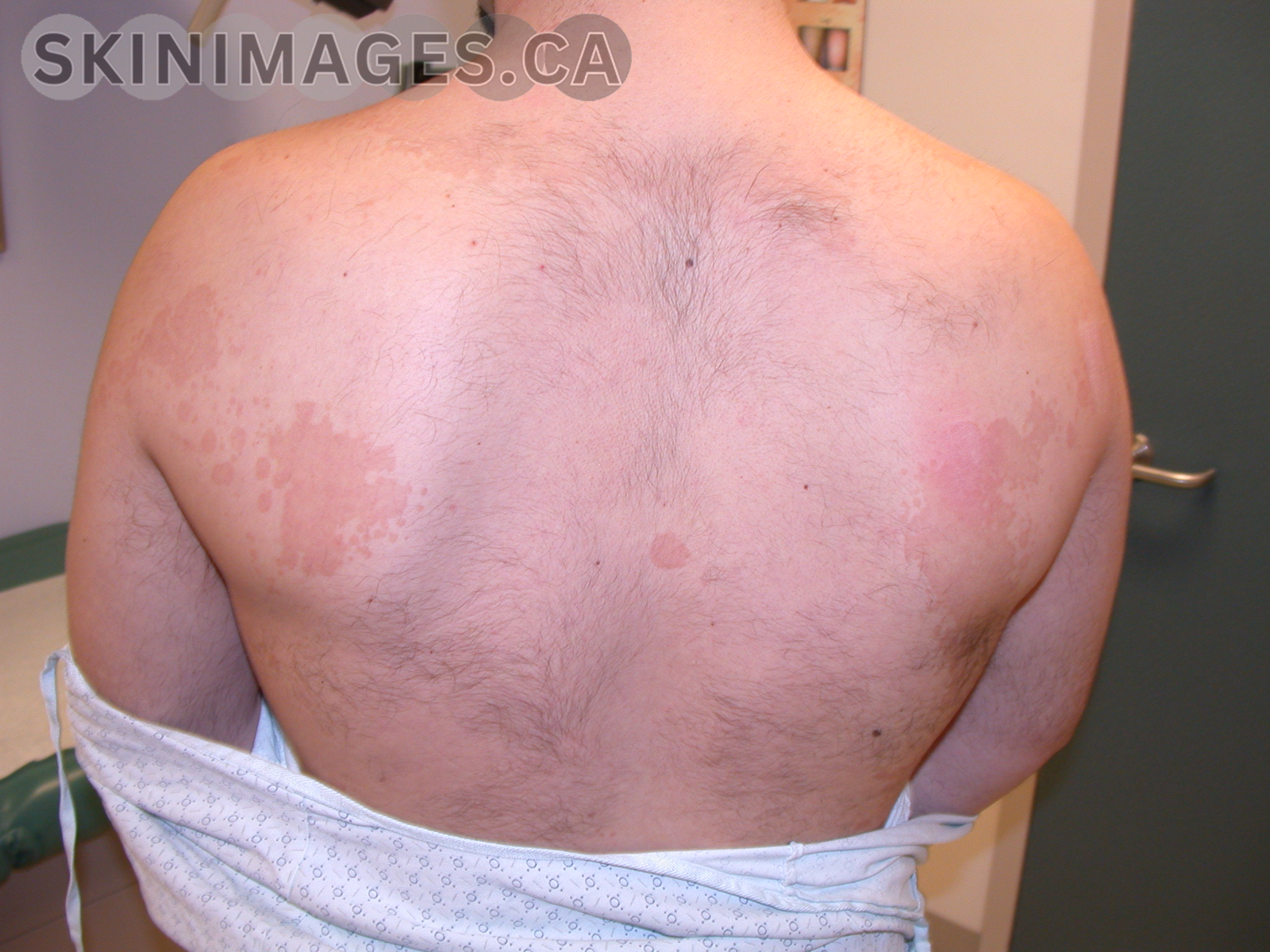
Pityriasis Versicolor, also known as Tinea Versicolor, is a common superficial fungal infection caused by the yeast Malassezia. It typically affects adolescents and young adults, particularly in warm, humid climates. The condition presents with hypo- or hyperpigmented macules, often on the trunk, neck, and upper arms, which may coalesce into larger patches with fine scaling. Pale patches may be more common among patients with deeper skin pigment. The affected areas usually do not tan, leading to a characteristic contrast with the surrounding skin. Diagnosis is usually clinical, supported by a potassium hydroxide (KOH) examination or Wood’s lamp. Treatment includes topical antifungals such as selenium sulfide, ketoconazole, and clotrimazole, while oral antifungals such as fluconazole or itraconazole may be used for more extensive or recurrent cases. Recurrences are common, particularly in humid climates, and preventive treatments may be necessary. The prognosis is excellent, with most patients responding well to treatment. However, the skin discolouration may take time to resolve even after the infection is cleared, and regular prophylactic treatment might be required in cases of frequent recurrences.
References:
Leung AK, Barankin B, Lam JM, Leong KF, Hon KL. Tinea versicolor: an updated review. Drugs Context. 2022;11:2022-9-2. doi:10.7573/dic.2022-9-2
Kallini JR, Riaz F, Khachemoune A. Tinea versicolor in dark-skinned individuals. Int J Dermatol. 2014;53(2):137–41. doi:10.1111/ijd.12345.
Gupta AK, Foley KA. Antifungal Treatment for Pityriasis Versicolor. J Fungi (Basel). 2015;1(1):13-29. doi:10.3390/jof1010013
Definition: Familial lipomatosis/lipomas is a hereditary condition characterized by the development of multiple lipomas, which are benign tumours composed of mature fat cells. These soft, mobile, and usually painless nodules can occur anywhere on the body but are most commonly found on the trunk, forearms, and thighs.
Etiology: The condition is inherited in an autosomal dominant pattern.
Epidemiology: Familial multiple lipomatosis affects both men and women, with lipomas typically appearing in adulthood.
Signs: The presence of multiple subcutaneous lipomas, which can vary in size from small (a few millimetres) to large (several centimetres).
Symptoms: Although the lipomas are generally asymptomatic, they can become painful if they compress nerves or other structures.
Differentials: Other conditions causing subcutaneous nodules or tumours, such as neurofibromas, cysts, or liposarcomas, may be considered.
Diagnosis: Diagnosis is based on clinical examination, family history, and, if necessary, imaging or biopsy to rule out other conditions.
Treatment: Treatment is usually not necessary unless the lipomas cause discomfort, restrict movement, or are cosmetically concerning. Management options include surgical excision, liposuction, and, in some cases, injection lipolysis. Regular monitoring is recommended to manage potential complications and assess the need for intervention.
References:
Brodland, D. G., & Thomas, J. R. (2005). Lipomas and liposuction. In Cummings Otolaryngology-Head and Neck Surgery (4th ed., pp. 2914-2922). Elsevier.
Definition: Hidradenitis SUppurativa (HS), also known as acne inversa, is a chronic inflammatory skin condition that affects the apocrine-gland-bearing skin. It is characterized by painful, persistent deep-seated nodules, abscessed as skin tunnels that may develop purulent discharge and result in scarring.
Etiology: HS development may have genetic, environmental and behavioural influences. There is an autosomal dominant transmission pattern of HS. A loss-of-function mutation of the y- y-secretase complex involved in the Notch signalling pathway has been identified as a cause of HS. Other mutations include the DCD, PSTP 1P1, SOX9 and KLF5 genes. Environmental and behavioural factors are also relevant as individuals with HS often have co-morbidities that may lead to increased skin friction, sweat overproduction and retention and hormonal changes, which can increase the progression and severity of HS.
Epidemiology: The global prevalence of HS is variable, and may affect up to 4.1% of the population. In North American and European patients, HS is three times more women in females than males. In South Korea and Japan, HS is more common in males. HS typically manifests at puberty and is most active between 20 – 40 years of age. It may resolve at menopause in women. Risk factors include a family history of HS, obesity and metabolic syndromes, cigarette smoking, African ethnicity, IBD- particularly Crohn’s disease and other skin disorders.
Signs: Characteristic primary HS nodules are deep nodules typically 0.5- 2cm in size and can persist for days to months. The lesions may resemble recurrent, rupture-prone boils and have a serosanguinous discharge which may become purulent. The affected areas include the axilla, neck, inframammary folds, inner upper thighs, and anogenital region. The characteristic features of HS also include double open-ended comedones, painful firm papules and nodules, pustules, abscesses, draining sinuses linked to inflamed lesions, and atrophic and hypertrophic scars. The scars or plaques may cause architectural distortion and “tombstone” comedones.
Symptoms: Many patients report prodromal symptoms like burning, stinging, pain pruritus or hyperhidrosis which may precede a lesion by 12 hours. Triggers include menstruation, obesity, stress, heat, hormonal changes, and perspiration.
Diagnosis: HS may be diagnosed clinically. Three components of a triad must be met to diagnose HS: characteristic lesions, typical distribution and presence and recurrence of lesions. Skin biopsy can help confirm an HS diagnosis. Histopathological features include follicular occlusion and hyperkeratosis, infundibular follicular epithelial hyperplasia, keratin plugging, epidermal psoriasiform hyperplasia and plasmacytic infiltrate.
Treatment: General measures for treatment include smoking cessation, weight reduction, analgesics, loose-fitting clothing and improved hygiene. Specific medical treatment includes topical antibiotics or benzoyl peroxide, systemic antibiotics and oral hormonal therapies and immunomodulatory treatments. Procedural measures include incision and drainage of acute abesses and local excision of persistent nodules. Laser ablation of nodules, hair removal and radical excision of an affected area.
References:
Ballard K, Shuman VL. Hidradenitis Suppurativa. In: StatPearls. Treasure Island (FL): StatPearls Publishing; May 6, 2024.
Definition: Herpes zoster, also known as shingles, is a localized, painful, blistering rash that is caused by a reactivation of the varicella-zoster virus.
Etiology: The varicella-zoster virus (VZV) is a member of the Herpesvirales order of double-stranded DNA viruses, that causes chickenpox. The VZV establishes latency in the dorsal root ganglia nerve cells of the spinal cord after primary infection. Once reactivated, the virus replicates in neuronal cell bodies and migrates down sensory nerves to the skin, causing herpes zoster. Pain associated with zoster is due to inflamed nerves that are affected by the virus. The virus can be transmitted via skin-to-skin contact or droplet inhalation.
Epidemiology: The incidence of herpes zoster is 1.2- 3.4 per 1000 persons per year in individuals younger than 65 years. In individuals older than 65 years, the incidence is 3.9- 11.8 per 1000 persons per year. Recurrences are often seen in immunocompromised patients.
Signs: The dermatological involvement of herpes zoster is centripetal and follows a dermatomal distribution pattern. This is typically unilateral and may vary depending on the affected dermatome, age and health of the patient. Following the onset of pain, the rash that erupts is a crop of red papules that is painful, erythematous and blistering. On dark skin, the “shingles band” may appear as gray, dark brown or violaceous papules. The rash then develops forming vesicles which can cause discolouration of the surrounding skin depending on skin tone.The lesions continue to erupt and become pustular and crust over.
Symptoms: Early symptoms include localized or widespread pain without tenderness or skin changes. The zoster rash is painful within the associated area of skin. Individuals may feel unwell with a fever and headache. In uncomplicated cases, pain and general symptoms subside as the eruption disappears.
Diagnosis: Herpes zoster is diagnosed clinically with pain, characteristic morphology and dermatomal distribution. The rash may form a pattern called the zosteriform herpes simplex. Diagnostic tests include direct fluorescent antibody, PCR and Tzanck smear of vesicular fluid or blood.
Treatment: Several antiviral drugs are available to treat shingles such as acyclovir and valacyclovir. They shorten the length and severity of illness. Over-the-counter pain relief medication can also aid in the pain caused by shingles. The CDC recommends 2 doses of the recombinant zoster vaccine to prevent shingles and its complications in individuals 50 years and older. Vaccination is also recommended in younger, immunocompromised patients.
References:
Nair PA, Patel BC. Herpes Zoster. In: StatPearls. Treasure Island (FL): StatPearls Publishing; September 4, 2023.
Ayoade F, Kumar S. Varicella-Zoster Virus (Chickenpox). In: StatPearls. Treasure Island (FL): StatPearls Publishing; October 15, 2022.
Definition: Herpes zoster, also known as shingles, is a localized, painful, blistering rash that is caused by a reactivation of the varicella-zoster virus.
Etiology: The varicella-zoster virus (VZV) is a member of the Herpesvirales order of double-stranded DNA viruses, that causes chickenpox. The VZV establishes latency in the dorsal root ganglia nerve cells of the spinal cord after primary infection. Once reactivated, the virus replicates in neuronal cell bodies and migrates down sensory nerves to the skin, causing herpes zoster. Pain associated with zoster is due to inflamed nerves that are affected by the virus. The virus can be transmitted via skin-to-skin contact or droplet inhalation.
Epidemiology: The incidence of herpes zoster is 1.2- 3.4 per 1000 persons per year in individuals younger than 65 years. In individuals older than 65 years, the incidence is 3.9- 11.8 per 1000 persons per year. Recurrences are often seen in immunocompromised patients.
Signs: The dermatological involvement of herpes zoster is centripetal and follows a dermatomal distribution pattern. This is typically unilateral and may vary depending on the affected dermatome, age and health of the patient. Following the onset of pain, the rash that erupts is a crop of red papules that is painful, erythematous and blistering. On dark skin, the “shingles band” may appear as gray, dark brown or violaceous papules. The rash then develops forming vesicles which can cause discolouration of the surrounding skin depending on skin tone.The lesions continue to erupt and become pustular and crust over.
Symptoms: Early symptoms include localized or widespread pain without tenderness or skin changes. The zoster rash is painful within the associated area of skin. Individuals may feel unwell with a fever and headache. In uncomplicated cases, pain and general symptoms subside as the eruption disappears.
Diagnosis: Herpes zoster is diagnosed clinically with pain, characteristic morphology and dermatomal distribution. The rash may form a pattern called the zosteriform herpes simplex. Diagnostic tests include direct fluorescent antibody, PCR and Tzanck smear of vesicular fluid or blood.
Treatment: Several antiviral drugs are available to treat shingles such as acyclovir and valacyclovir. They shorten the length and severity of illness. Over-the-counter pain relief medication can also aid in the pain caused by shingles. The CDC recommends 2 doses of the recombinant zoster vaccine to prevent shingles and its complications in individuals 50 years and older. Vaccination is also recommended in younger, immunocompromised patients.
References:
CDC. Shingles. Centers for Disease Control and Prevention. Published 2019. https://www.cdc.gov/shingles/about/index.html
Nair PA, Patel BC. Herpes Zoster. In: StatPearls. Treasure Island (FL): StatPearls Publishing; September 4, 2023.
Ayoade F, Kumar S. Varicella-Zoster Virus (Chickenpox). In: StatPearls. Treasure Island (FL): StatPearls Publishing; October 15, 2022.
Definition: Herpes zoster, also known as shingles, is a localized, painful, blistering rash that is caused by a reactivation of the varicella-zoster virus.
Etiology: The varicella-zoster virus (VZV) is a member of the Herpesvirales order of double-stranded DNA viruses, that causes chickenpox. The VZV establishes latency in the dorsal root ganglia nerve cells of the spinal cord after primary infection. Once reactivated, the virus replicates in neuronal cell bodies and migrates down sensory nerves to the skin, causing herpes zoster. Pain associated with zoster is due to inflamed nerves that are affected by the virus. The virus can be transmitted via skin-to-skin contact or droplet inhalation.
Epidemiology: The incidence of herpes zoster is 1.2- 3.4 per 1000 persons per year in individuals younger than 65 years. In individuals older than 65 years, the incidence is 3.9- 11.8 per 1000 persons per year. Recurrences are often seen in immunocompromised patients.
Signs: The dermatological involvement of herpes zoster is centripetal and follows a dermatomal distribution pattern. This is typically unilateral and may vary depending on the affected dermatome, age and health of the patient. Following the onset of pain, the rash that erupts is a crop of red papules that is painful, erythematous and blistering. On dark skin, the “shingles band” may appear as gray, dark brown or violaceous papules. The rash then develops forming vesicles which can cause discolouration of the surrounding skin depending on skin tone.The lesions continue to erupt and become pustular and crust over.
Symptoms: Early symptoms include localized or widespread pain without tenderness or skin changes. The zoster rash is painful within the associated area of skin. Individuals may feel unwell with a fever and headache. In uncomplicated cases, pain and general symptoms subside as the eruption disappears.
Diagnosis: Herpes zoster is diagnosed clinically with pain, characteristic morphology and dermatomal distribution. The rash may form a pattern called the zosteriform herpes simplex. Diagnostic tests include direct fluorescent antibody, PCR and Tzanck smear of vesicular fluid or blood.
Treatment: Several antiviral drugs are available to treat shingles such as acyclovir and valacyclovir. They shorten the length and severity of illness. Over-the-counter pain relief medication can also aid in the pain caused by shingles. The CDC recommends 2 doses of the recombinant zoster vaccine to prevent shingles and its complications in individuals 50 years and older. Vaccination is also recommended in younger, immunocompromised patients.
References:
Nair PA, Patel BC. Herpes Zoster. In: StatPearls. Treasure Island (FL): StatPearls Publishing; September 4, 2023.
Ayoade F, Kumar S. Varicella-Zoster Virus (Chickenpox). In: StatPearls. Treasure Island (FL): StatPearls Publishing; October 15, 2022.
Definition: The Herpes Simplex Virus (HSV) is a virus that causes herpes. Herpes is a common infection that can cause painful ulcers or blisters that may recur over time. The virus will remain dormant throughout a person’s life with the number of outbreaks decreasing with age. Two subtypes can cause infection: Herpes Simplex virus type 1 (HSV-1), and Herpes Simplex virus type 2 (HSV-2).
Etiology: The HSV is a member of the Herpesvirales orderof double-stranded DNA viruses. Both HSV subtypes affect the skin and mucous membranes. HSV is transmitted from oral or skin surfaces affected by the virus. Rarely, herpes can be transmitted vertically, causing neonatal herpes.
While HSV-1 is associated with oral and facial infections, HSV-2 is associated with genital and rectal infections. Unique features of HSV include latency and reactivation. Following primary exposure there is a viral invasion of epithelial cells and intracellular replication at the site. HSV then ascends through the periaxonal sheath of sensory nerves to the host sacral ganglia- which acts as a reservoir for future outbreaks. As the virus replicates, it is dormant and can be reactivated by various stimuli.
Epidemiology: As of 2016, the WHO estimates that 3.7 billion people under 50, (67% of the global population) had an HSV-1 infection, causing oral or genital herpes. It is estimated that 491 million people aged 15-49 worldwide were affected by HSV-2-causing genital herpes. Prevalence of HSV infection increases with age. The highest number of new infections is seen in adolescents. Women are affected by HSV-2 twice as often as men due to a more efficient route of sexual transmission.
Signs: HSV infections are characterized by recurrent blisters that can rupture and become painful. Initial presentation can appear as painful genital ulcers, inguinal lymphadenopathy and fever. Areas that can become affected by clustered vesicles are the genitalia, perineum, buttocks, upper thigh, and perianal areas. The vesicles are small, umbilicated, and closely grouped with an erythematous base in recurrent herpes. They may have a zosteriform distribution when affecting the lower chest or lumbar region. In darker skin tones, scarring at the site of recurrent HSV attacks is more prominent and hyperpigmented.
Symptoms: Symptoms may vary between the initial outbreak and subsequent infections. Prodromal symptoms can appear up to 48 hours before an outbreak. These include fever, tender lymph nodes, myalgia, itching and tingling of the skin. Primary HSV-1 often presents as gingivostomatitis in children under 5 years. Primary HSV-2 usually presents as genital herpes following sexual activity.
Differentials: Herpes Zoster, Syphilis, Cytomegalovirus, Chancroid, Hand foot and mouth disease
Diagnosis: HSV diagnosis can be confirmed by culture or PCR of a viral swab taken from fresh vesicles.
Treatment: HSV cannot be cured, so treatment is aimed at decreasing symptoms associated with first or recurrent episodes of herpes. Antiviral medication is commonly given in low daily doses to prevent outbreaks. NSAIDS can be given to help with pain related to sores.
Cole S. Herpes Simplex Virus: Epidemiology, Diagnosis, and Treatment. Nurs Clin North Am. 2020;55(3):337-345. doi:10.1016/j.cnur.2020.05.004
World Health Organization. Herpes simplex virus. Who.int. Published April 5, 2023. https://www.who.int/news-room/fact-sheets/detail/herpes-simplex-virus