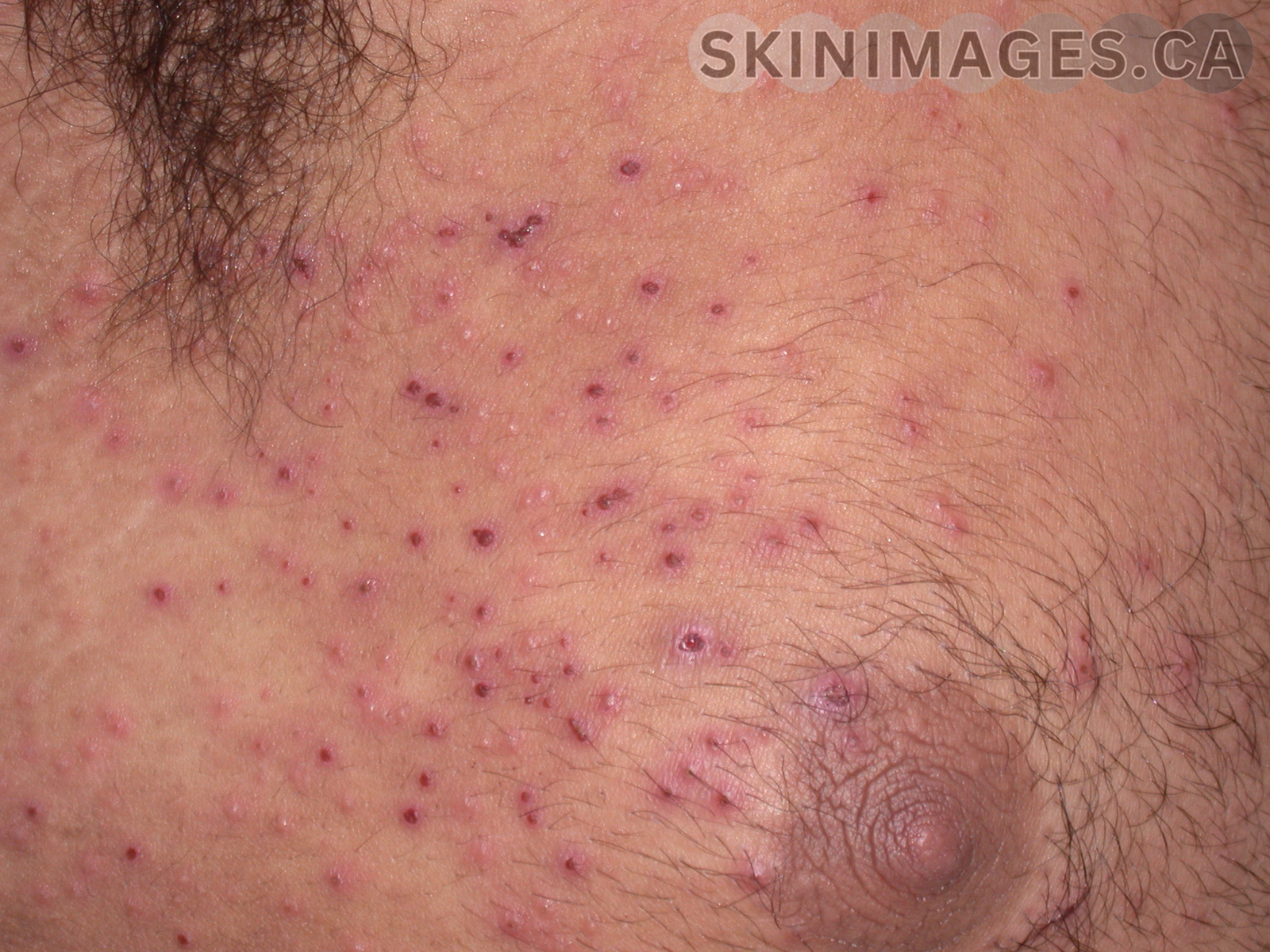
Body Part: Torso

  • Epidermal Nevus

    Epidermal Nevus

    Author: Kawaroreet Karwal MS2, Y, Miller-Monthrope, Dermatologist/Dermatopathologist, Toronto, Canada, 2024

    Definition: Epidermal nevus is a benign skin condition characterized by the overgrowth of epidermal cells, resulting in the formation of warty or verrucous plaques. 

    Etiology: These lesions typically present at birth or develop early in childhood and can persist throughout life.

    Epidemiology: Epidermal nevi are rare, occurring in approximately 1 in 1,000 live births. They are most commonly found on the trunk, limbs, and neck. 

    Signs: The lesions are often linear or segmental, following the lines of Blaschko, and can vary in colour from flesh-toned to brown.

    Symptoms: Symptoms associated with epidermal nevus include pruritus and irritation, particularly if the lesions are inflamed or become secondarily infected. In rare cases, epidermal nevi can be part of broader syndromes, such as epidermal nevus syndrome, which may involve neurological, skeletal, and ocular abnormalities.

    Treatment: Treatment for epidermal nevus is primarily aimed at managing symptoms and improving cosmetic appearance. Options include topical treatments, such as keratolytics and retinoids, and surgical interventions like excision, laser therapy, or cryotherapy. The choice of treatment depends on the size, location, and symptoms associated with the nevus.

    References:

    1.     Hafner, C., & Vogt, T. (2008). Sebaceous Gland Disorders. In Harper’s Textbook of Pediatric Dermatology (Vol. 2, pp. 235-246). Wiley-Blackwell.

    2.     Happle, R. (2000). The group of epidermal nevus syndromes part I. Well-defined phenotypes. Journal of the American Academy of Dermatology, 42(2), 171-183.

    3.     Patel, S., Zirwas, M., & English, J. C. (2010). Treatment of epidermal nevi: a systematic review. Journal of the American Academy of Dermatology, 62(1), 19-28.

  • Eczema Herpeticum

    Eczema Herpeticum

    Eczema Herpeticum

    Author: Kawaroreet Karwal MS2, Y, Miller-Monthrope, Dermatologist/Dermatopathologist, Toronto, Canada, 2024

    Definition: Eczema herpeticum (also known as Kaposi varicelliform eruption) is a severe, potentially life-threatening skin infection caused by the herpes simplex virus (HSV) in individuals with atopic dermatitis or other underlying skin conditions. 

    Epidemiology: It typically occurs in children and young adults but can affect individuals of any age. 

    Symptoms: Eczema herpeticum usually presents with clusters of painful, monomorphic, punched-out erosions that rapidly spread over eczematous skin areas. The affected areas may become swollen, and the lesions can develop into pustules, vesicles, and crusts. Systemic symptoms such as fever, malaise, and lymphadenopathy may also be present. 

    Diagnosis: Early diagnosis and treatment are crucial to prevent complications. Antiviral medications, such as acyclovir or valacyclovir, are the primary treatment options and should be administered promptly. In severe cases, hospitalization may be required for intravenous antiviral therapy and supportive care. Corticosteroids and antibiotics may be used to manage concurrent inflammation and bacterial infections.

    References:

    1.     Eichenfield, L. F., Tom, W. L., Chamlin, S. L., Feldman, S. R., Hanifin, J. M., Simpson, E. L., & Paller, A. S. (2014). Guidelines of care for the management of atopic dermatitis. Journal of the American Academy of Dermatology, 71(1), 116-132.

    2.     Wollenberg, A., Oranje, A., Deleuran, M., Simon, D., Szalai, Z., Kunz, B., … & Taïeb, A. (2016). ETFAD/EADV eczema task force position paper on diagnosis and treatment of atopic dermatitis. Journal of the European Academy of Dermatology and Venereology, 30(5), 729-747.

    3.     Hebert, A. A., & Rodriguez, L. A. (2016). Management of eczema herpeticum in children. Pediatric Dermatology, 33(4), 357-361.